
March 19, 2019
I spent the first weekend of March in Chicago to see two shows I felt warranted the trip: English National Ballet’s Giselle, choreographed by Akram Khan, at the Harris, and a shared, mixed repertory program featuring local company Hubbard Street Dance Chicago and Malpaso Dance Company, hailing from Cuba, at the Auditorium.
While I enjoyed Hubbard and Malpaso’s joint show—all of their dancers are beautiful to watch, and the collaborative aspect of the evening (Hubbard’s Robyn Mineko Williams choreographed a piece for Malpaso, and Malpaso’s Osnel Delgado created a work for Hubbard) was inspiring—I found that ENB’s Giselle elicited a much deeper response in me.
This new imagining of Giselle, featuring a corps de ballet of migrant workers (as opposed to the classic version’s peasants) and an imposing group of landlords (rather than nobles), translates the story into today’s terms—highlighting current issues of social polarization, immigration, marginalization, income inequality, the list goes on. And, not only was the ballet made more relevant by the recontextualization, it was also beautiful and arresting to watch.
************
Akram Khan’s Giselle is a ballet of dichotomies and tensions, mirroring and making apparent the direction in which societies across the world seem to be moving.
The divide between the migrant workers and their landlords is made clear visually, in costuming and setting, but most vividly in gestures and temporality. The migrant workers move with ease, dancing rhythmically and together, and with the music, in “real time,” using their entire bodies. The landlords don’t really move much at all; they gesture, mostly with their arms, while the rest of their bodies are largely still and stiff. And these gestures are performed more slowly than one would move in “real life,” and discernibly more slowly than the workers move. The landlords move as if they have all the time in the world and know they are being watched. They are unhurried and deliberate in all of their limited actions. Bathilde, Albrecht’s betrothed, removes each of the fingers of one of her gloves individually and precisely; practically nothing else happens onstage, despite the many onlookers, worker and landlord alike. Everyone’s eyes are drawn to her slow motions. This contrast in body language, between the two groups, is a great source of tension, and the tension builds because of the contrasting paces of these disparate corporeal languages—each refined and specific to its own kind.
Throughout the ballet, I noticed a shifting back and forth between molasses-y sections and quicker, more urgent segments. The ongoing fluctuation drew me in, building my attention and interest in the world and characters of the ballet. The music’s volume mirrored this ongoing deviation—soft at certain moments and then rising to almost abrasively loud at others.
Khan mixes beautifully the vocabularies of classical ballet and Kathak, one of the forms of classical Indian dance. There is contrast here as well, but also a gorgeous mélange. He finds opportunities to make the movements complement one another. One of my friends with whom I attended the performance commented afterward that one of her favorite moments was when a group of women used one “ballet arm” and the other “Kathak arm” to create an entirely new port de bras position. Khan uses this dichotomy of styles to create fresh possibilities for movement, demonstrating a positive way to utilize differences.
When speaking of dichotomies and divisions, I would be remiss if I failed to mention the set of this ballet. The stage is devoid of everything but a massive stone wall that separates the workers from the landlords. The wall can push forward and pull back, narrowing or deepening the stage; it can also spin around a central horizontal axis, splitting the stage to create two parallel planes. The wall is a visual representation of this theme of division, and through its movement, both helps to tell the story of the ballet and also to show how divides can shift, be broken, and reconstructed in different places, ways, and for different people.
The costumes, too, create an immediately apparent separation between the two sects of people in the ballet. The migrant worker women wear simple dresses, in subdued tones, and the men are dressed likewise in plain pants and tunics. No one stands out from the group, but they also are not necessarily donning a uniform. The landlords, in high contrast, wear reds, blacks, and whites, a Queen of Heart’s court. Each of the women’s garments is individualized, dazzling: Bathilde has a black-toned, full skirt, with black accents on a nude top, while another woman wears a dress of all white with a skirt that extends about three feet outward on either side, like Mother Ginger in The Nutcracker. Bathilde’s father wears multiple layers of black, and what appear to be his footmen wear coats of rich reddish velvet. They stand out. This particular dichotomy is rendered even more striking by the fact that the migrant workers are in the garment industry. Lifting a portion of Bathilde’s skirt, Giselle recognizes her own handiwork.
************
Khan’s Giselle is also a celebration of community, and its power. Whenever the migrant workers are dancing together, you can feel a collective pulse. They move to the rhythm of the musical score, and also in perfect time with one another. They mostly look like they enjoy dancing together. The movement itself is not particularly virtuosic—few high leg extensions, few awe-inspiring jumps—and the women wear flat shoes. The impact of the movement for me lay in its performance by a large group and the precision with which it was executed in this group.
The Wilis too, in the second act, (all en pointe here) move as one. They are forbidding and imposing; their strength is derived largely from their power as one collective body. They appear unstoppable, with their flowing hair swaying together, their feet bourrée-ing in sync, and the long wooden sticks they carry raised and pointed in unison. Khan exposes the tectonic power created by communities acting with a common purpose, even when, or perhaps especially when, these communities are comprised of marginalized people, as are the migrant workers and Wilis. Important to note is that the Wilis are women. In their land, the women rule; they have palpable power, made clear through body language and props, which can inflict real harm. They share their power with, and make space for, one another. They dominate, and they prevail.
A memorable display of collective power occurs when Giselle is near death. Her fellow workers and members of her community circle her in concentric circles, their bodies low to the ground and their arms linked, rising and falling as if breathing as one creature. They seem to form a source of communal support, as Giselle heads to her tragic end.
************
I couldn’t help but to think about Khan’s new rendering of the ballet in contrast to the traditional version. I certainly wasn’t distracted in the moment by trying to compare the two; rather, a couple of instances of Khan referencing the original naturally jumped out at me. The first, and perhaps more obvious of these, is the score’s use of snippets of the original music. It wasn’t overpowering, or self-conscious, and I appreciated the subtle inclusion of a few strands of the original score here and there. The second moment was fleeting but apparent and delicious: the Wilis performed, briefly, the classic arabesque chugs from the original choreography in the second act. It presented a moment for the balletomanes in the audience to think, “Aha! There’s a ‘Giselle moment!’”
************
Coincidentally, I saw ENB’s big new ballet production a week after seeing The Joffrey Ballet’s Anna Karenina, another ambitious new show. While the Joffrey dancers were in peak form, the ballet’s overall impact, especially in comparison to that of Khan’s Giselle, was limited. Whereas Khan and ENB explore relevant matters of immigration and marginalization, and feature women exhibiting real power and control in the form of the Wilis, through a poignant recontextualization of a classic, The Joffrey tells the outdated story of Anna Karenina as if “word for word.” Khan’s Giselle answers the question of why we need this ballet now, while The Joffrey’s Anna Karenina fails to explain why today’s audience should be sent back in time to watch an overwrought bourgeois drama about Imperial Russian society. Giselle challenges its audience to think about the fraught society in which we live today, while Anna Karenina invites us to escape it in a whirlwind of fanciful costumes, projections, and moving set pieces.
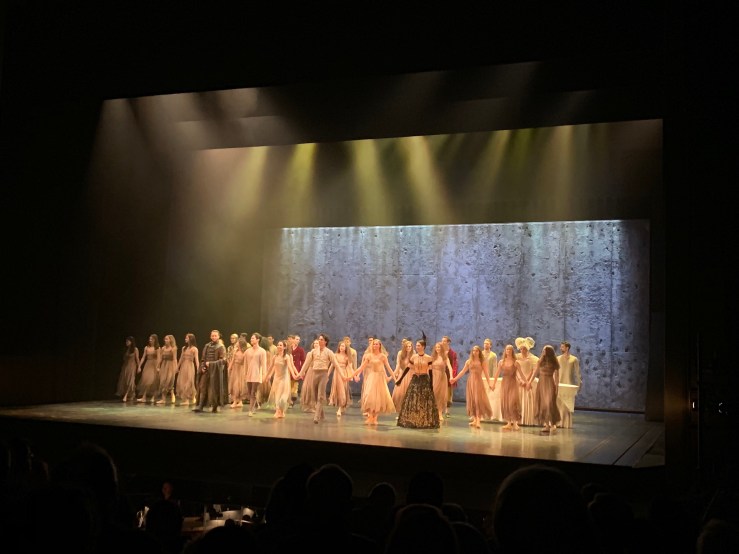 ENB dancers bowing after the Saturday matinee performance of Akram Khan’s “Giselle,” during the recent engagement at Chicago’s Harris Theater.

 Dance As I See It