
April 8, 2019
There seems to be a “moment” now in the dance world in which female ballet stars are creating gala-style productions outside of the typical company model—productions that showcase themselves, choreography in which they’re interested, and groups of friends and peers they bring together for the occasion. This week’s Pure Dance program of Natalia Osipova’s at New York City Center is an example of this current “happening”; so too are Maria Kotchetkova’s upcoming program at The Joyce and Sara Mearns’s project at the Pillow. I’m looking forward to (hopefully) seeing both this summer.
As conversations about representation in the dance world continue, particularly in the subset that is the ballet world, and particularly in regards to gender and race, these projects seem to offer women artists, in a male-dominated profession, the opportunity to assert themselves and to demonstrate their skill in curating, directing, and generally being “in charge” in a sphere they know well.
************
Osipova’s City Center program provides audiences with the opportunity to see live her illustrious partnership with American Ballet Theatre leading dancer David Hallberg. Discourse surrounding their partnership centers on the perfect match of her open, emotive dancing and his more reserved and gentle style; “opposites attract” to form a complex and complete whole in their twosome.
The highlights of this program then, naturally, were the two bookend pieces in which Osipova and Hallberg danced together: The Leaves are Fading by Antony Tudor and Valse Triste by Alexei Ratmansky, made for the two.
Though the pieces were, unfortunately, accompanied by recorded, not live, music, they showcased beautifully the chemistry between Osipova and Hallberg, especially in the Ratmansky piece. In both, their joy in dancing together was palpable—there was an energy apparent, and the way that they made eye contact with one another was telling of their delight in dancing together and the trust they have in one another.
Valse Triste’s choreography provided moments for them to dance the same or similar steps in unison, and another opportunity, through this skillful paralleling, for the audience to witness their “in sync-ness.” Certain movements in particular offered the chance to feature both of their extremely articulated, highly arched feet. The multiple diving leaps that Osipova makes into Hallberg’s arms demonstrate not only the dancers trust in one another, but also their desire and ability to take risks together they might not otherwise take without the other.
Ratmanksy is the most deft choreographer on this program. His musicality stands out; he noticeably responds to the music in his steps in a way that is less apparent in the other five pieces (with the runner-up being Tudor’s classic work, which is perhaps a reason I’m so drawn to ballet—the choreographers generally use better music, and respond more articulately to it).
************
I was less interested to see the more contemporary pieces on the program—I wanted to see Osipova do what she’s known for: classical ballet! However, I was pleasantly surprised by Roy Assaf’s well-crafted, narratively and visually interesting duet for Osipova and Jason Kittelberger, Six Years Later. Assaf builds a complex relationship between the individuals that draws the audience in: will the next section show the pair in a fraught moment, or a time of contentment? There was a story here, about a romantic relationship between a man and a woman, but Assaf leaves room for the audience to make choices about what might be happening to the two or might have happened before to lead them to the point at which the dance begins. Osipova here looked confident in the contemporary movement, and there were many lovely partnering sections.
************
Hallberg took the stage in a solo by Kim Brandstrup, In Absentia. While the piece itself didn’t move me (though it did seem to explore some interesting themes of self-criticism, and the transmission of an ephemeral art such as dance from one to another), it was engaging to see Hallberg dance alone, taking up the whole space of the stage. His lines are splendid, like those out of a teaching manual on ballet. He did a repeated step of a double outside passé turn that then extended into an arabesque. Exactly as one’s ballet teacher would instruct, he lifted the extending leg up from the knee as he elongated his leg into arabesque. There was no dropping down of the leg. It was pristine.
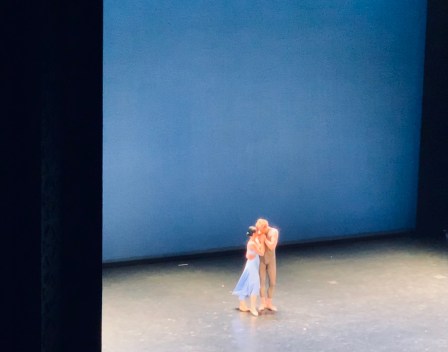
Natalia Osipova and David Hallberg embrace after dancing Alexei Ratmansky’s “Valse Triste.”

 Dance As I See It